Azusa Street Revival of 1906
The Azusa Street Revival of 1906 was a move of
God that began in a humble mission in Los Angeles
and became the spark that ignited the modern
Pentecostal movement.
It started with only a few hungry believers. The setting
was far from grand: a dusty, weathered building at
312 Azusa Street, once used as a stable and
warehouse.
Yet from that unlikely place, the Spirit of God moved
in a way that changed the Church forever. At the
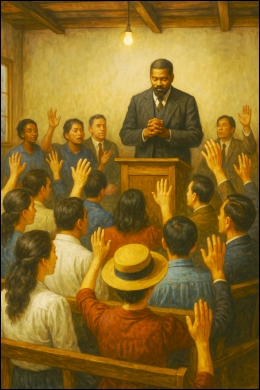
center stood William J. Seymour, an African-American
preacher blind in one eye, with little formal training
but a life marked by prayer, holiness, and humility.
Because of segregation, Seymour had often been
forced to sit outside the classroom when biblical
teaching was given. What he lacked in polish or
credentials, he carried in surrender and faith. His
message was simple yet profound: sanctification,
holiness, and the baptism of the Holy Spirit with the
evidence of speaking in tongues.
What followed was nothing short of supernatural. The
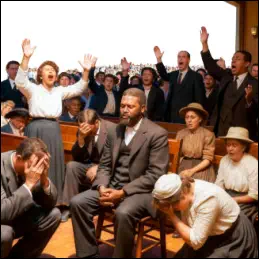
meetings were unstructured and Spirit-led. Seymour
often sat quietly in prayer, sometimes with his head
bowed inside a wooden crate, as the Spirit moved
freely. There was no program and no agenda.
People were overcome with conviction, repented, and
rose filled with the Holy Ghost. Many spoke in
tongues, others were healed, and countless lives
were transformed.
Azusa Street became a place where barriers were
torn down. Black, white, Hispanic, Asian, rich and
poor, educated and uneducated all gathered
together, drawn by the same hunger for God. In a
deeply segregated America, Azusa was a radical
expression of unity in Christ. Here Joel’s prophecy
was lived out: “I will pour out my Spirit upon all flesh.”
The meetings lasted for several years, peaking
between 1906 and 1909, and reports spread rapidly.
Newspapers mocked the gatherings as disorderly and
fanatical, while many church leaders denounced
them. Yet none of that stopped the flow of people who came from across the nation and around the
world to experience the outpouring. Missionaries were sent, evangelists were empowered, and
churches were planted. What began in one simple mission spread across the globe, giving birth to
the Pentecostal movement, which today numbers in the hundreds of millions.
But the true power of Azusa was not just in what was seen or heard, it was in the presence. Many
who walked into the building felt an overwhelming conviction before a word was spoken. Others
testified of healing during worship. Children prophesied. Ordinary men and women spoke in
languages they had never learned. It was revival in its purest form: God’s glory filling ordinary lives.
In time, as with many revivals, division, denominational disputes, and human attempts to control the
work of the Spirit caused the fire to wane. The meetings eventually faded, but the impact never did.
Azusa Street stands as a testimony that God uses the humble and the hungry, not the powerful or
prestigious, to carry His fire.
The same God who visited that little mission in 1906 is still moving today. If He did it then, He can do
it again.
Copyright © 2025 www.shaping-of-nations.com
All rights Reserved No portion of this site may be copied or transmitted
without express written permission from Shaping of Nations.
Listen to this article.
The Impact of the Azusa Street Revival
What began in a modest mission at 312 Azusa Street soon sent ripples across the world, breaking
down racial and social barriers at a time when segregation was the norm. For three years, people
from every walk of life came together in unity, drawn by a shared hunger for the presence of
God.
From this unlikely setting, missionaries and evangelists went out across America and beyond.
They carried a message of Spirit baptism, holiness, and the gifts of the Holy Ghost. Churches and
ministries were birthed, and the revival gave momentum to what is now the fastest-growing branch
of Christianity. Today, more than 600 million believers trace their spiritual heritage back to the
fires of Azusa Street.
The true legacy of Azusa is not only in its numbers but in its demonstration that God uses the
humble and surrendered to ignite global change. The revival proved that revival is not confined
to grand cathedrals or famous leaders but flows through ordinary people yielded to God’s Spirit.