Copyright © 2025 www.shaping-of-nations.com
All rights Reserved No portion of this site may be copied or transmitted
without express written permission from Shaping of Nations.
Cane Ridge Revival of 1801
The Cane Ridge Revival of 1801 stands as
one of the most extraordinary moments in
American religious history, a gathering that
shook the frontier and revealed the contrast
between a living faith and rigid institutional
religion.
Darkest Egypt : In the 1790s, Kentucky
was known as “Darkest Egypt.” Fewer than
one in a hundred showed real interest in God.
Churches closed, attendance dwindled, and
even members lived in open sin. Ministers
despaired that Christianity itself might
disappear from the frontier.
Into this darkness came James McGready, a
fiery Presbyterian who settled in Logan
County in 1796. He preached repentance,
holiness, and the new birth, but also called his people to prayer and fasting. In 1797, his congregations
pledged to pray every Saturday night and Sunday morning, and to fast monthly for revival. This
covenant of prayer became the seedbed of what was to come.
Sparks of Revival : In June 1800 at Red River Church, the first breakthrough came. Worshipers
trembled, wept, and turned to Christ. A month later, at Gasper River, crowds so large they couldn’t fit
indoors gave birth to America’s first camp meeting. Thousands came, and manifestations of shouting,
tears, and falling spread across the gathering. The wildfire had begun.
The Great Outpouring : By August 1801,
revival fires were blazing. At Cane Ridge,
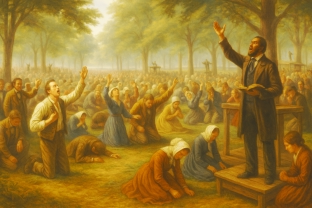
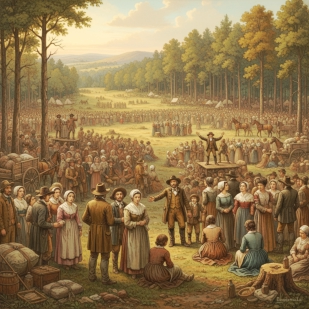
under Barton W. Stone, an astonishing 20,000
to 25,000 people gathered, in a wilderness
clearing cut from the forest to hold the crowds.
People came on foot, horseback, and wagon,
desperate to encounter God. Denominations
set aside differences to preach repentance and
salvation. The presence of God fell with power.
Some lay on the ground for hours under
conviction until they cried out for mercy. Others
shouted with joy, testifying to healing and
deliverance.
There was no schedule or plan, only the
unmistakable sense that heaven had touched
earth. From Cane Ridge, the camp meeting
spread across America, fueling what became
the Second Great Awakening.
Opposition and Division: Not everyone rejoiced. Many church leaders condemned the revival as
emotionalism or even the work of the devil. The trembling, falling, and shouting offended their
traditions. Conflict with the Presbyterian Synod soon followed.
By 1803, Barton W. Stone and four other ministers withdrew and formed the Springfield Presbytery. But
within a year, they dissolved it with their Last Will and Testament, declaring that believers should be
known simply as Christians, that the Bible alone was their rule of faith, and that denominations only
divided.
Legacy : By 1805, the visible fervor had faded, but the legacy endured. The Stoneite “Christian”
movement spread, emphasizing unity and Scripture. The camp meeting model multiplied, fueling
Methodist and Baptist growth and planting thousands of churches across the South and frontier West.
In the 1830s, Stone’s “Christians” united with Alexander Campbell’s “Disciples,” forming the
Restoration Movement. Their aim was to restore the New Testament church, a legacy still seen today
in the Churches of Christ, Christian Churches, and Disciples of Christ.
Conclusion : From the depths of “Darkest Egypt,” God raised up a movement that shook America.
Cane Ridge was more than a week-long meeting, it was a turning point that spread revival fire, birthed
new movements, and left a legacy still shaping the church today.



Listen to this article.